
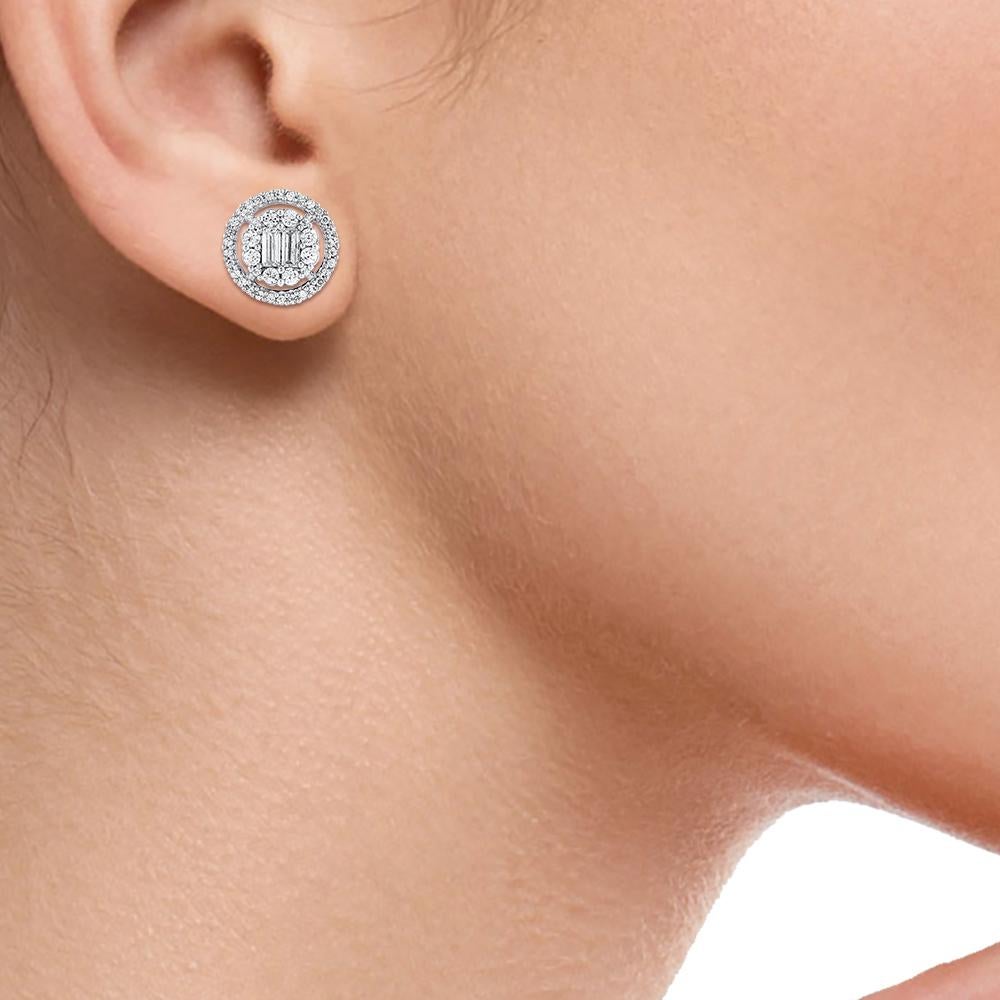
A stud earring may look tiny in a product photograph and unexpectedly bold once it is on your ear. The difference often comes down to just a few millimeters. For a polished everyday look or a more noticeable statement, the best starting point is the size of the visible earring—not the carat number alone.
As a practical guide, 3–4 mm studs tend to look delicate, 5–6 mm offer a classic everyday presence, and 7–8 mm or larger read as more prominent. These are style suggestions, not universal fit rules: the same stud can appear very different depending on earlobe proportions, setting, and piercing position.
Quick size advice: For subtle sparkle, begin near 3–4 mm. For a balanced solitaire, consider 5–6 mm. If you want an earring that stands out across the room, explore 7–8 mm and above. Measure an existing favorite before making your final choice.
Stud earring size chart: 2 mm to 10 mm
These ranges describe the approximate visible diameter or width of a simple stud design. A halo, flower, square outline, or unusual prong arrangement can make an earring look larger than the center stone's measurement suggests.
| Size | General impression | Styling idea |
|---|---|---|
| 2–3 mm | Very small, almost a pinpoint | Quiet accent or a delicate layered look |
| 3.5–4 mm | Petite, refined sparkle | Understated workday or minimal style |
| 5–6 mm | Clearly visible, still versatile | Classic single-piercing stud |
| 6.5–7 mm | Noticeable focal point | Defined sparkle with simple outfits |
| 8–10 mm+ | Bold, substantial presence | Evenings and statement styling |
A size chart cannot display jewelry at true physical scale on every screen. Use the listed millimeters, a ruler, and your own ear proportions before ordering.
How to measure stud earrings in millimeters
- Check what the product measures. A listing might describe the center gemstone, the finished earring face, or its overall width and height. Those are not interchangeable.
- Measure a stud you already enjoy wearing. Place it face up near a millimeter ruler and measure the visible design at its widest point. For a round stone, check the diameter; for a square or oval design, check both height and width.
- Compare the shape, not only the number. A 6 mm Asscher-cut stone has a square outline, while a 6.5 mm round stone appears circular. A halo or cluster may extend beyond its center gemstone.
- Look at the earring on your own ear. Note where your piercing sits, how much lobe is visible around the earring, and whether a larger top might need a supportive backing.
If a product page gives only total carat weight, it may not contain enough information to know the exact face-up size. Ask for the measurement rather than converting the weight into a definite millimeter value.
Millimeters vs. carat weight: what is the difference?
Millimeters describe physical dimensions. Carats describe weight. The abbreviation cttw generally refers to combined stone weight for a pair or the stated collection of stones—not necessarily the weight of one earring.
For example, a pair listed at 0.50 cttw of natural diamonds does not have a 0.50-carat diamond in each ear. Likewise, a CZ earring's listed carat weight should not be used as a direct diamond-size conversion: cubic zirconia and diamond have different densities, and different cuts distribute mass differently.
The buying rule: to choose how large your studs will look, prioritize verified millimeter measurements, shape, and setting over a carat label.
What looks best on small or larger earlobes?
The most flattering effect usually comes from the relationship between the stud and your own ear, rather than following a rigid chart. On a petite lobe, a 5 mm stud might fill much of the visible surface. On a larger lobe, the same stud may read as delicate. The height of your piercing also changes how the jewelry sits.
For a soft, minimal result, begin with a design that leaves comfortable space around the visible earring. For more impact, choose a larger front that still rests securely and does not tilt forward. A heavier stud can feel different from a lightweight one even when the face-up dimensions are the same.
Choosing your stud earrings by style and occasion
For work or everyday elegance
Small-to-medium solitaire studs are easy to pair with a blazer, dress, or knitwear. If you wear glasses or keep your hair tucked behind your ears, consider whether you prefer an understated 3.5 mm point of sparkle or a more visible 5–6 mm look.
For an evening outfit
A larger, bright round stud can hold its own against a dressy neckline, swept-back hair, or a bolder lip color. An 8 mm solitaire offers a strong focal point without requiring a dangling earring.
For a second piercing or curated ear
A smaller stud near another earring can create intentional contrast. Check that the two settings have enough space so they do not touch or snag when your ear moves.
For a gift
If you cannot measure the recipient's existing jewelry, look for photographs where their earrings are visible and note whether they favor delicate or more prominent shapes. A classic round or square stud is versatile, but material preferences and comfort matter too.
Five Suzy Levian studs to compare by size
Here are five currently listed Suzy Levian styles with verified dimensions. The first two listings provide approximate earring measurements; the remaining three describe the center cubic zirconia dimensions. That distinction is important when comparing them.
3.5 mm: the delicate diamond stud
For the person who loves an understated glimmer, these 14K white-gold studs feature two round natural diamonds totaling 0.20 cttw. The catalog lists an approximate 3.5 mm earring measurement, making this the smallest of our five examples. Four-prong settings and butterfly backs complete the classic silhouette.

5.2 mm: a refined everyday focal point
These polished 14K white-gold four-prong studs have two round natural diamonds totaling 0.50 cttw. The listed 5.2 mm approximate earring measurement creates more presence than the 3.5 mm pair, without shifting to a dramatic stud. Compare the stated measurements—not just the carat totals—when choosing between the two.

6 mm: a modern Asscher-cut outline
Each stud features a 6 mm Asscher-cut white cubic zirconia, prong-set in sterling silver with a butterfly closure. The catalog lists 2.50 cttw for the pair, referring to cubic zirconia rather than diamond. Its square, step-cut geometry looks different from a round solitaire even when the size is similar.

Shop the 6 mm Asscher-Cut White Cubic Zirconia Stud Earrings
6.5 mm: the noticeably bright round stud
These classic studs have 6.5 mm round-cut white cubic zirconia stones, set in 925 sterling silver with butterfly backs. The description specifies 2 cttw of cubic zirconia for the pair. This is a clear, rounded point of sparkle for someone who wants the earring to be visible without choosing the largest option.

Shop the 6.5 mm Round-Cut White Cubic Zirconia Stud Earrings
8 mm: the standout statement solitaire
At 8 mm per round white cubic zirconia stone, these sterling-silver studs occupy noticeably more of the earlobe. The catalog lists 4 cttw of cubic zirconia for the pair, with prong settings and butterfly backs. Choose this scale for a stronger solo statement or an evening look, while considering your own lobe size and comfort.

Stud earring backs and comfort matter, too
Even the most beautiful earring needs to sit comfortably. Butterfly backs, sometimes called friction backs, are common for stud styles, including the five examples above. A back that feels secure on one pair may not be ideal for every post thickness, earlobe, or earring weight.
Before wearing a new pair all day, check that the back is fully engaged, the stud does not tip forward, and the post does not press uncomfortably against the skin. For heavier or larger tops, ask a jeweler about appropriate support rather than forcing a tight backing. Remove earrings before sleeping, exercise, or activities likely to pull or catch the jewelry.
Stud earring size FAQ
Are 4 mm studs too small?
Not if you want subtle sparkle. A 4 mm front often reads as delicate, particularly for everyday wear or a second lobe piercing. The appearance depends on your ear and the design.
Are 6 mm stud earrings big?
For many people, 6 mm is a clearly visible mid-sized look, not an oversized statement. A 6 mm Asscher cut, however, will not look identical to a 6 mm round stone or a 6 mm flower design.
What is the difference between 6 mm and 8 mm studs?
Two millimeters may sound small, but for a circular design an 8 mm front has about 78% more visible face area than a 6 mm circle. That change can be noticeable on an earlobe, even though both are compact pieces of jewelry.
Are diamond studs measured by carats or millimeters?
Both can appear in a listing, but they measure different things. Carat weight tells you the weight of the diamond or diamonds; millimeters give you a physical dimension. For the visual size on the ear, millimeters are the more direct measure.
Will an 8 mm stud look good for everyday wear?
It can, especially if you enjoy a bold look. Check the earring's weight and balance, and make sure its backing keeps the front comfortably positioned. Personal preference matters more than a universal size rule.
The finishing touch is your own sense of proportion
Whether your favorite pair is a barely-there natural diamond or a more dramatic cubic zirconia solitaire, knowing the dimensions puts you in control of the look. Use the size chart for a first impression, then check each product's actual measurement, shape, and setting. If material is part of your decision, explore our cubic zirconia vs. diamond guide and our guide to 925 sterling silver and 14K gold.